

Effects tell tale of Boston missionary who perished in WWII
In its office at the archdiocese’s Pastoral Center in Braintree, the Archdiocese of Boston’s Pontifical Mission Society has numerous articles that serve as living reminders of the missionary spirit that has been a part of the archdiocese since its founding in 1808 -- among them, the desks of Cardinal Richard Cushing and Boston’s first bishop, Bishop Jean-Louis Lefebvre de Cheverus.
The director of the office, Father Thomas Kopp, works at Cardinal Cushing’s desk. Before he became archbishop, then-Father Cushing directed Boston’s Propagation of the Faith office. Bishop Cheverus was a missionary priest in North America who became Boston’s first bishop in 1808.
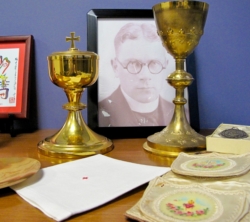
During the Mass celebrated at the cathedral to mark World Mission Sunday last month, the office honored the legacy of another pioneering missionary priest of the archdiocese, Father James Hennessy, by offering the Mass for him and displaying his articles.
More than just priestly artifacts, however, the chalice, ciborium, burse, and pix that are now on display in the archdiocesan mission office, are living reminders of a pioneering priest who died on mission he had long sought, even if that meant standing up to a cardinal.
Father Hennessey’s personal effects were received about 40 years ago by the office’s former director, Msgr. Andrew Connell, when a group of visitors from the Solomon Islands surprised him with a visit. They came bearing reminders of Father Hennessy, a well-respected and loved missionary priest who served in the Solomon Islands before being killed during World War II.
According to Msgr. Connell, Father Hennessy was the first Boston diocesan priest to serve as a foreign missionary.
The visit, according to Msgr. Connell, was indicative of Father Hennessy’s popularity with the Solomon Island’s natives.
“They were faithful to Father Jim. They loved Father Jim,” Msgr. Connell said. “He had become a part of them. They had devotion. They knew that he had hidden them.”
Msgr. Connell said that Father Hennessy buried the artifacts in his backyard in the islands because he did not want them to be taken by the Japanese and desecrated.
During this time, the United States and her allies were attempting to beat back Japanese aggression in the area.
According to Pilot file reports, Father Hennessy was born on Sept. 24, 1905 in North Cambridge. He studied at St. John’s Seminary and North American College in Rome before being ordained on Dec. 20, 1930 in Rome. Prior to his missionary work, he was an associate pastor at Immaculate Conception Parish in Malden from July to September, 1931 and then served for almost five years as an associate pastor at the Cathedral of the Holy Cross.
While stationed at the cathedral, Father Hennessy approached the then-Father Richard Cushing, who would later become a cardinal and Archbishop of Boston, to volunteer to serve as a missionary, according to Msgr. Connell.
In response, according to Msgr. Connell, Father Cushing told the young priest that he could volunteer to assist the next bishop who came to the propagation office seeking a missionary. As it would turn out, that bishop was Bishop Thomas Wade, a Marist bishop of the North Solomon Islands.
Meanwhile, Father Hennessy had to get permission from Cardinal William O’Connell, then the Archbishop of Boston, to serve as a missionary.
“Most of the priests were afraid of him, and the people too,” said Msgr. Connell. “He was very strict.”
“He went and told him what he would like to do,” Msgr. Connell added. “The cardinal thought he was a little bit crazy. It was unheard of. No priest of the archdiocese went to a foreign mission.”
Cardinal O’Connell rejected Father Hennessy’s request. Father Hennessy then asked a second time, and got the same response from the cardinal, Msgr. Connell said.
“He didn’t forget,” Msgr. Connell said. “I guess he had a lot of courage.”
When Father Hennessy approached Cardinal O’Connell a third time, he relented.
“The cardinal was sort of exasperated with this young priest who had the audacity to pressure him, and he said, ‘Go, and your going will be a blessing to the archdiocese,’” Msgr. Connell said.
Msgr. Connell said that according to Bishop Wade, Cardinal O’Connell’s statement was vague; it was unclear if the cardinal meant Father Hennessy’s work was a blessing for the archdiocese or if the blessing was that Father Hennessy was going to leave the archdiocese.
Father Hennessy was granted a term of five years by the cardinal, according to Msgr. Connell, and Father Hennessy received an extension when Bishop Wade requested he remain there longer.
While there, he founded the first seminary in the Pacific islands, according to Msgr. Connell.
Barely into his second term, Father Hennessy was captured by the Japanese and shortly thereafter met his death.
However, Msgr. Connell said there are two differing accounts of Father Hennessy’s demise.
One account says that Father Hennessy died when his prisoner of war ship, the Montevideo Maru, bound for Tokyo was sunk by American forces. Another account reports that natives saw his beheading by a Japanese soldier while he was still on the beach.
According to the website of the Australian War Memorial, the Montevideo Maru was sunk by a submarine on July 1, 1942.
The Pilot, at the time, reported that Father Hennessey perished on the Montevideo Maru.
“He went down there and spread the faith, and he was taken prisoner because he was a priest and an American,” Msgr. Connell said. “He died for the faith because that was the reason he was there, which I think would constitute him as a true martyr of the faith.”
Father Hennessy’s missionary service was the beginning of the archdiocese’s lend-lease program, initiated by Cardinal Cushing, allowing priests of the archdiocese to serve missions in the United States and abroad.
“It all came about because of Cardinal Cushing’s love that he developed for the missions while in the propagation of the faith office,” Msgr. Connell said.
Years later, Cardinal Cushing founded the Father Jim Hennessy Mission Club in his honor. The club also had a women’s equivalent, the Sen Fu Club. “Sen Fu,” Msgr. Connell explained, is Chinese for respected or venerable and was the title the Chinese would give missionaries to their country.
Msgr. Connell praised Father Hennessy’s willingness to journey to the Solomon Islands to spread the faith.
“He was a wonderful priest -- very dedicated and willing to give his life for the spread of the Gospel,” Msgr. Connell said. “He just volunteered as he promised Father Cushing he would do. It was kind of an act of faith he made that God would lead him to the missions with the next bishop that visited Boston.”
“He had that love for the universal Church, and that love for the missions,” Msgr. Connell added. “When you have that love of the faith, it seeps down to the people that you serve.”