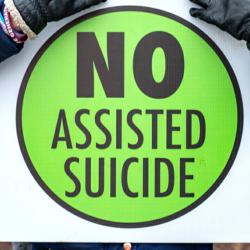
It could lead to an increase of suicide generally: Oregon, the first state to legalize physician-assisted suicide, has one of the highest rates of suicide (not including deaths from PAS) of any state in the nation. It begs a logical question: How can a state effectively both try to minimize suicide in some situations and promote it as a legal alternative in other situations? Is it reasonable to expect that efforts to prevent suicides will be undermined by legalizing suicide and presenting it as normal and acceptable for those with terminal diagnoses?
It could lead, eventually, to euthanasia -- like it has in the Netherlands: It is very sobering to see the evolution of physician-assisted suicide in the Netherlands, a modern industrialized country. In 1973 the "Right to Die -- NL" was founded and euthanasia has been legal in the Netherlands for more than a decade. The New York Times reported in their April 3, 2012, edition that "Right to Die -- NL" is campaigning for expanded euthanasia, in the form of mobile teams to go out to people's homes to euthanize them. They are also promoting the idea that euthanasia should no longer be limited just to the terminally ill, and their proposal envisions the service for any individual over 70 years of age who requests it.
The Dutch patients' organization, NPV, strongly criticizes the current application of the law, saying the practice of euthanasia has been extended to include patients with dementia and other conditions who may not, by definition, be competent to request help in dying, including children. Elise Van Hock-Burgerhart, a spokeswoman for NPV, told the New York Times reporter that the idea of mobile euthanasia teams was a matter of concern because there was no way for the mobile team doctors to get to know the patients. Moreover, she stated that research in the Netherlands indicated that requests for euthanasia from the elderly would be substantially reduced if palliative care were better in their country and that the country should be working toward improving palliative care, not increasing euthanasia. She also indicated that the law in the Netherlands required review committees to sign off on every reported case of euthanasia, but that 469 cases from 2010 had still not been reviewed; 2010 is the latest year for which data is available. That year 3,136 notifications of termination of life on request were reported, indicating that it was not clear how well doctors were adhering to the official guidelines. Anyone that believes that a "slippery slope" doesn't exist with assisted suicide and euthanasia only has to look at its "evolution" in the Netherlands.
In the United States we are still a long way from the Dutch situation; however, this is not because the laws in the two states that allow PAS are well written or because of careful oversight. What has put the brakes on the growth of physician-assisted suicide in the U.S. is that more than 20 states have rejected proposed legislation and ballot initiatives.
Now it is our turn in Massachusetts to stop this bad idea and bad law from going into effect. Please join me to stop assisted suicide by voting "No on Question 2" on Election Day.
The Archdiocese of Boston has developed an educational website on the Church's teachings on end of life issues,
www.SuicideIsAlwaysATragedy.org. The archdiocese is also part of a large coalition of groups from other faiths, from the medical community, and from disabilities rights groups that are advocating a no vote on Question 2. The coalition's website is
www.StopAssistedSuicide.org.