

Faith
... there are many "ifs, ands, or buts" about liturgical calendars. There are as many how, what, when, where, who, and why questions regarding our celebrations in the calendar.
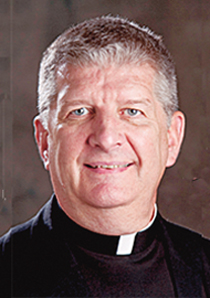
Father Robert M.
O'Grady
O'Grady
The beatification of Archbishop Fulton Peter John Sheen on Sept. 24 gave rise to a couple of questions related to the liturgy.
During the formula in the decree for the beatification, the date that will eventually be his feast day was announced as Dec. 9.
In the current edition of the Roman Martyrology, where Blessed Fulton John Sheen's name will be entered on that date, there are already six saints, including St. Juan Diego Cuauhtlatoatzin; there are also three individual blesseds and a group of blesseds. St. Juan is an optional memorial on the General Roman calendar.
Whether Blessed Fulton's memorial can be observed is a simple question, but with simple questions there are often complex answers.
The short answer is that his feast cannot be observed -- yet.
Since this is a calendar question, the next several columns will be dedicated to liturgical calendars. This also involves questions of saints and blesseds, so that will need to be addressed. Then, how a specific saint or blessed gets on a specific calendar.
You will not be surprised to know that there are categories of saints and blesseds (e.g., martyrs, religious, pastors), and within the categories, there are ranks with different levels of celebrations -- solemnity, feast, memorial and optional memorial. And to add to the complexity, the ranks can vary from country to country, or more correctly from one conference of bishops to another, which may be one country or encompass several nations.
The Roman Missal provides the best guide to categories. In the section of the missal designated "Commons," you will find martyrs, with Mass prayers for martyrs who were also missionaries, virgins or holy women; then pastors with Mass texts for popes, bishops, pastors, founders of churches and missionaries. There are also Doctors of the Church; then virgins (non-martyrs); then holy men and women (including abbots, monks, nuns and religious); then those who practiced works of mercy; educators; and holy women.
The Commons are the texts for those who do not have a set of prayers of their own, or propers. That is a collect, a prayer over the gifts, and a prayer after Communion, and sometimes a preface.
As you might guess, some saints can be included in more than one category. St. Irenaeus of Lyon, a very early Father of the Church, is a martyr in AD 191, a bishop, and since 2022, a Doctor of the Church. Meanwhile, St. Therese of Lisieux, Little Flower, is a virgin, religious, and, since 1997, a Doctor of the Church.
When the saints can be celebrated can also be affected by the liturgical season in which their assigned date is being observed, or not.
For example, Lent requires a great deal of sobriety, while Easter is the opposite. Yet, within both seasons there are limits. The appearance of Alleluia is eliminated throughout Lent, not only as the Gospel acclamation but also elsewhere, such as in psalms, hymns, etc. During the Octave of Easter -- Easter Sunday through the Second Sunday of Easter -- nothing may replace those days. The season called Ordinary Time provides the greatest opportunity for the celebration of saints' feasts. If your parish were named St. Dominic, whose memorial is Aug. 8 and that date falls on a Sunday (as it will in 2027), you could celebrate him in your parish as a solemnity. His day with its prayers and readings could replace the 19th Sunday in Ordinary Time that year.
Closer to home, there is the case of March 17.
Unless it is a Sunday -- and if it is a Sunday, it would always be a Sunday of Lent -- the feast of St. Patrick could be celebrated on March 17 as follows in our archdiocese.
Throughout the archdiocese, all the Masses, except funerals and nuptial Masses, of March 17 would be celebrated as his feast because he is the principal patron of the archdiocese and has been since Pope St. John Paul II declared it on Oct. 15, 1991. In the parishes of which he is the patron -- Boston, Brockton, Lawrence, Lowell, Natick, Stoneham, and Watertown -- this day is a solemnity. According to tradition, on solemnities, the penitential obligations of fast and abstinence do not apply where his solemnity is celebrated. But those obligations do apply if it is simply a feast or a memorial.
As these few examples already indicate, there are many "ifs, ands, or buts" about liturgical calendars. There are as many how, what, when, where, who, and why questions regarding our celebrations in the calendar.
Try to keep in mind that it's not just the Church that has multiple calendars. In our country, we have a national calendar; think federal holidays and observances. We also have state calendars with their holidays and observances, and even some county and city ones. Depending on the day and its rank -- federal, state, local -- banks may be closed or not; mail may be delivered or not; schools and local civic offices may be closed or not.
So, these issues are not unusual. We'll continue looking at Church calendars in the coming weeks. As always, don't hesitate to send along questions to rmogrady@TheBostonPilot.com.
Help us expand our reach! Please share this article on social media

Recent articles in the Faith & Family section
-

Saints, blesseds, and other heroesFather Robert M. O'Grady
-

'Francis, rebuild my Church'Archbishop Richard G. Henning
-

There is Union in Communion!Maureen Crowley Heil
-

Living on the vineScott Hahn
-

Remembering Mexico's persecution a century laterArchbishop Jose H. Gomez


